I was down in London yesterday - and stopped in the Museum of London. I'm so excited - I bought the report entitled "The royal palace, abbey and town of Westminster on Thorney Island: Archaeological excavations (1991-8) for the London Underground Limited Jubilee Extension Project". A bit of a mouthful, but what a find. It has maps of the area from prehistory to the modern day. It is possible (thanks to photocopying onto transparencies) to compare each period with the modern streets and buildings. It gives such an insight into the way the area developed (and why).
I hope to share some of the findings over coming weeks.
Showing posts with label British History. Show all posts
Showing posts with label British History. Show all posts
Tuesday, 4 June 2013
Sunday, 21 April 2013
London
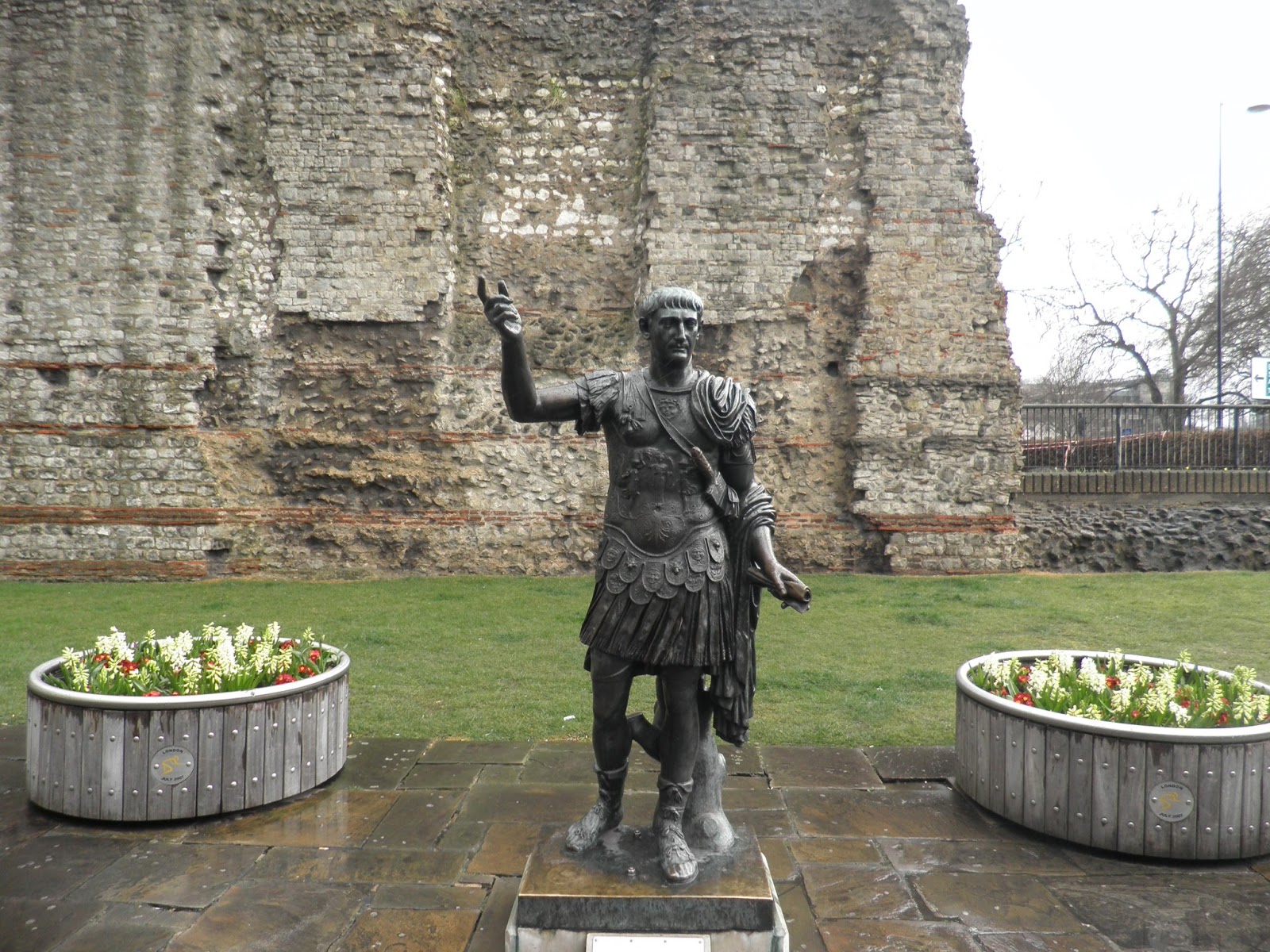
I've recently enjoyed a couple of days walking around London. Not my usual haunts around Westminster - but the old Roman settlement of 'Londinium'. This Roman 'new town' (the Milton Keynes of its day) was established within seven years of the invasion of Britain. There may have been earlier settlement in the area, but this was a planned new town.
Londinium was build in an area north of the (then much wider) Thames, which included what we now know as Ludgate Hill [where St Paul's is close to the summit] and Cornhill [where the main Forum was built)]. The River Fleet (now buried underground was the major river flowing into the Thames at the western end of the settlement). Between Ludgate Hill and Cornhill the "Walbrook" ran. Only a couple of weeks ago announcements were made about the significance of the finds on a site where the stream used to run. [Details here and BBC video].
Armed with the Museum of London's "Londinium" maps (1981 and 2011 editions - both are useful and complemented each other. An application showing Londinium's sites imposed on top of a modern map is available here.) I walked around the modern city.
These are two photographs taken from London Bridge showing the extent of the settlement along the river. Blackfriars Bridge (with the new covers for the extended platforms) marks the western end where the Fleet met the Thames.

The Tower of London marks the eastern end.

The current bridge lies a few feet to the west of the original Roman bridge. Of course the first "Londinium" had a short life. After only a decade it was burnt during Boudica's rebellion. But a new "Londinium" was soon built, which prospered greatly.
It was well worth visiting the Museum of London. There are some excellent displays and models to help a visitor understand the Roman city - and how it developed into today's London. I was surprised how much of the walls of London are now visible - and how marked the two hills of Ludgate and Cornhill remain.
I also visited the amphitheatre which lies below the Guildhall. The Museum of London and the Amphitheatre are open to the public. A series of pdfs describe the walk around the walls.


Sunday, 14 April 2013
Stony Stratford

I live in Milton Keynes - a place some people think has no history. [It is a 'New City', planned from the 1960s; developed since - and now with a population of almost a quarter of a million]. But it is full of history. A Roman Villa can be visited in Bancroft; the major Roman road, later known as Watling Street runs through the city (and close to where I live); ancient villages remain [often hidden within one of the estates on the grid] - and Bletchley Park is a site and now museum of international historical significance.
Then there is Stony Stratford - sitting on Watling Street. It wasn't a Roman town itself (MK's Roman town was 'Magiovinium' - to the South East of Fenny Stratford) - and there is evidence of roman settlement across the Great Ouse in Old Stratford - but it came into its own during the medieval period. Watling Street continued to be a major route across England - and stony Stratford developed as a coaching town. If you walk around you'll see the tell-tale signs of coaching inns -


After the death of Edward IV, his son - the twelve year old Edward - left Ludlow heading for London. At Stony Stratford his uncle, Richard of Gloucester [to become Richard III] - who was named as his protector in Edward IV's will - met with the young Edward V - and took him into his care.

This plaque can be seen on a property in Stony Stratford High Street. At the moment (in the little spare time I have), I'm reading about Richard III. As someone with many connections to Leicester (and a former tutor at Leicester University), I followed closely the developments involving the discovery of Richard III's body. Currently I'm part way through John Ashdown-Hill's fascinating book "The Last Days of Richard III".
In the interests of full disclosure I should mention that I've also recently joined the Richard III Society.
Friday, 12 April 2013
The Huguenots

However, it was revoked by Louis XIV in 1685 with the result that large numbers of French protestants fled to England to escape persecution. Over twenty thousand (out of an estimated 200,000 who fled France) of these religious refugees settled in Spitalfields, London.
This weekend in London there are a number of events to celebrate the contribution made to British life (and the silk-spinners who worked in Spitalfields, in particular). More details are available from Time Out.
Further information about the Huguenots can be found on the Huguenot Society's website.

Thursday, 30 August 2012
Coming Soon....

Washminster will return on Saturday 1st September. Initially I am aiming for a post, on average, every other day - but this will increase shortly. Please do pass the message on about the return of this blog.
In particular this blog should be of interest to those
* who are studying Law and Politics - particularly of the US and the UK
* who enjoy British history
* who enjoy US history
* who are interested in French and EU Government, politics and history
* who enjoying thinking about the practical application of political ideas
* who take an interest in UK, US & French election
so if any of those describe YOU - please subscribe to Washminster. If they describe any of your friends or students - drop them an email - or post about Washminster on Facebook or Twitter.
Many thanks
David

Thursday, 15 December 2011
The Making of the United Kingdom

A high speed history is given in the following sections
- Early Britain: from the arrival of man to the Norman Conquest in the 11th Century
- The Middle Ages: from late 11th Century to 1485
- The Early Modern Period: from the accession of Henry VII (accession is the polite term - he invaded England & overthrew Richard III at the Battle of Bosworth. (see my post of April 2011), his right to the throne by blood was pretty weak) to 1688.
- Stability and the Growth of Empire: from the reign of William & Mary (another Foreign led and financed invasion to replace a King who had outlived his welcome) to the outbreak of the First World War
- The Twentieth Century: mistitled section, as it only covers 1914 to 1945! (though an important period)
- Politics in Britain since 1945: from Labour taking power in 1945 to the last Labour Government (remember that the current edition is from 2007. I'm sure a new edition can't be far off)
Monday, 10 January 2011
Westminster Returns
Parliament returns this afternoon. Now it has its seat in the Palace of Westminster - but originally it met around the country. The King summoned Parliament to advise him - and the meeting place was where HE was. Over time the residential palace of Kings alongside the Thames became Parliament's home. King Canute is believed to have been the first King to live in Westminster. Henry VIII was the last. The House of Lords made the palace its permanent home long before the Commons. It was only in the late 1540's that the Commons were granted a permanent meeting place in St Stephen's Chapel.
There are some useful histories of Parliament available - my favourite is below
There are some useful histories of Parliament available - my favourite is below
Friday, 23 October 2009
A Radical History of Britain
 I have thoroughly enjoyed reading Edward Vallance's "A Radical History of Britain". Westminster - as I noted yesterday - is decorated according to historical preferences of those in the 19th Century. Some radicals are recognised, others have less prominence. For example there is no statue of John Wilkes - but there is a fine painting (with an excellent description of him as a campaigner for press freedom and parliamentary reform) just inside the Members Dining Room.
The "history" portrayed at Westminster is a little one sided - monarchy is generally good; the French are definitely bad....
Vallance's book is a refreshing contrast to the history of Kings and conformists. He sets out the tradition of radical thought and action in Britain - which is often overlooked. There are individuals described who came from Britain - but influenced events around the world - like Thomas Paine! The Peasants Revolt; Cade's Rebellion; the events surrounding the English Civil War and the Glorious Revolution; the struggle for extension of the suffrage; and the Suffragettes are all described.
All Brits should read this book - Americans can read of our shared tradition - and any citizen of the world can find this an interesting read.
The Facebook site for the book can be accessed from here.
A Guardian Review can be accessed here.
Wednesday, 23 September 2009
The Parliamentary Archives
 Every day Parliament produces a host of documents - Bills; Committee Reports; Hansard - and many others. It has been doing so for centuries. The collections in the Parliamentary Archives contain over three million records. Many of these documents have great historical significance.
Some of the cornerstones of the British constitution can be accessed here.
For scholars the records are important primary documents for their research. Once they were available to a priviliged few - but now increasing numbers of these records are available to many more people. Some have been digitised - To access these press here. The Archives at Westminster is usually open to the public all year round, Monday to Friday, 9.30am to 5.00pm (apart from public holidays).
As well as useful for researching Parliament; and British history (political and social), the records can be useful for investigating family trees. There is a guide for users.
To find out more about the Parliamentary Archives go to http://www.parliament.uk/publications/archives.cfm
Subscribe to:
Posts (Atom)